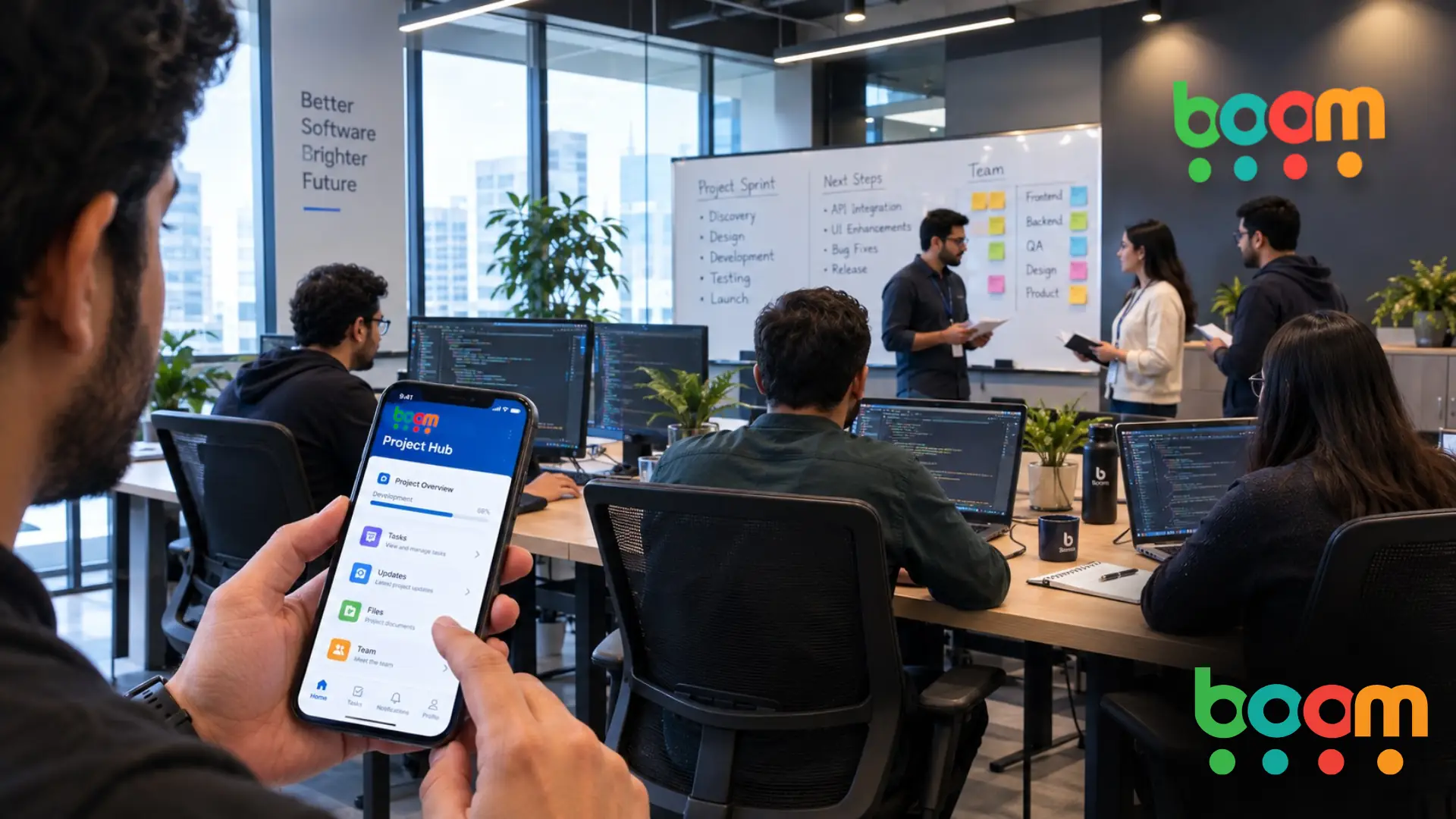
From Idea to App Store: Boom Software's End-to-End Development Process
Every app on your phone started as a rough idea on someone's notepad. Getting from that idea to a five-star listing on the App Store takes a clear process: one that turns a good brief into a focused scope, a focused scope into a well-built product, and a well-built product into an app people actually love using.
At Boom Software, we've built that journey into a repeatable process. Here's exactly how we take a client from "I have an idea" to "it's live."
1. Discovery: Understanding the Problem, Not Just the App
Before a single wireframe gets drawn, we sit down with the client to understand what they're actually trying to solve. Who's the end user? What's the workflow today, and how can we make it better? What does success look like six months after launch?
This stage shapes everything downstream. When we built a booking app for a private GP practice, the brief wasn't just "build a booking app." It was "make it effortless for patients to see a doctor without the friction of a phone call." That focus shaped how we approached the entire build.
2. Scoping and Planning
Once we understand the problem, we define the solution: core features, platform (iOS, Android, or both), timeline, and budget. We're deliberate about separating "must-have for launch" from "nice-to-have for v2": a lean, focused MVP gets to market faster and gives us real user feedback to build on, so every future release lands even better.
This is also where we agree on technical architecture: what needs a custom backend, what can lean on third-party services, and where the best balance between speed and flexibility sits.
3. Design: Turning Requirements into Screens
Our design team translates the scope into wireframes, then high-fidelity UI designs in Figma. We design for the platform conventions users already know and love. iOS and Android users come with certain expectations, and leaning into that familiarity is what makes an app feel effortless rather than distinctive for its own sake.
Clients review and sign off at this stage, before a line of code is written, so everyone starts development with total clarity and confidence in the direction.
4. Development: Building It Properly
This is where "vibe coding" and professional development part ways. Our engineers build on solid architecture: clean data models, proper API design, and code that's built to grow with the product long after launch. We work in short sprints, so clients see working builds regularly and stay involved every step of the way.
For apps like FlipVest, a property investment analysis tool with AI-driven deal scoring, ROI and refurb calculators, and area insights, this stage means bringing multiple data sources and calculation engines together cleanly, so the app stays fast and reliable as features grow.
5. Testing: Getting It Right Before Launch
Every build goes through structured QA: functional testing, device testing across screen sizes, and performance testing under real-world conditions. We also run usability passes with people outside the project, bringing in fresh eyes that catch what the build team might miss.
This is how we make sure the app clients launch is the polished, reliable product their users deserve from day one.
6. Launch: Getting Through the App Store Gate
Submitting to the App Store and Google Play is more than clicking "publish." Apple and Google both have detailed review guidelines, and we know them well. We handle store listing optimisation, screenshots, and the submission process itself, so clients get a smooth, confident path to going live.
7. Post-Launch: The Work That Actually Matters
An app's launch date is the beginning of its life, not the end. We stay involved after go-live, monitoring performance, refining features at scale, and building the next round of improvements based on real usage data. Several of our clients, including the team behind FlipVest, have come back to us for dashboards and features well beyond the original launch scope, because we're invested in their long-term success.
The Throughline
What makes this process work isn't any single stage. It's that each one feeds the next with real decisions, not assumptions. A clear discovery phase keeps scoping focused. A signed-off design keeps development moving with confidence. Thorough testing means launch day is something to look forward to.
If you've got an idea and you want a clear, confident path to the App Store, that's exactly the conversation we have for free before any commitment. Get in touch and let's scope it out.