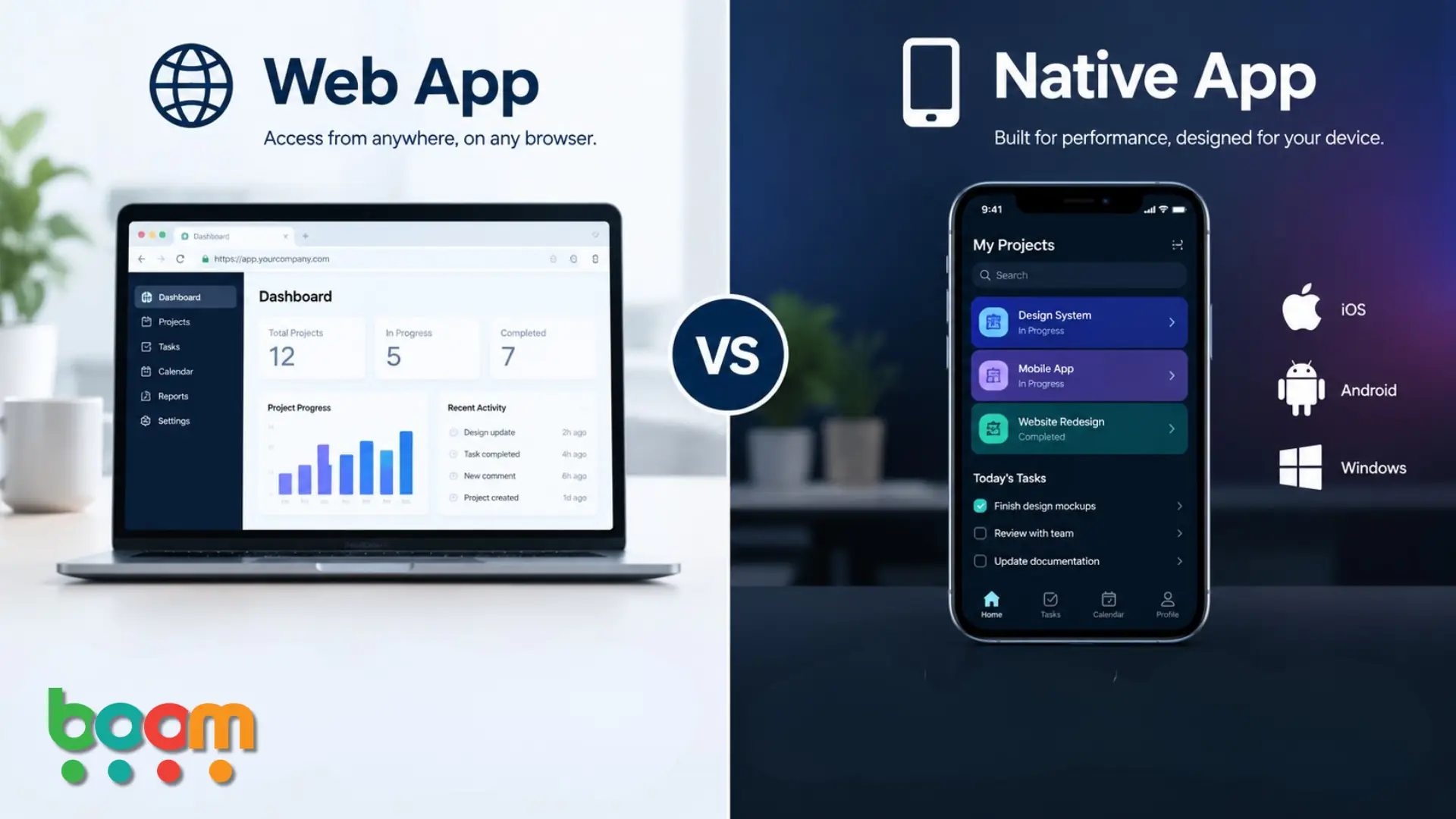
Web App or Mobile App: Which Should You Build First?
If you're a founder or business owner planning your first digital product, this is usually the first big fork in the road, and it's easy to get stuck on it. Competitors have an app, so you assume you need one too. Or a developer friend tells you to "just build a website first." Neither answer is right on its own. The right starting point depends on your product, your audience, and how people will actually use it.
It's also one of the most common questions we hear as an app development company UK founders come to before writing a single line of a brief. So here's how to think it through properly.
The real difference isn't technical, it's strategic
It's tempting to frame this as a tech decision, but it's really a decision about two different operating models. A web app is built for reach: it lives at a URL, works in any browser, and anyone can land on it from a search result, a link, or an ad with zero friction. A mobile app is built for retention: it lives on the user's home screen, sends push notifications, and is designed for people who'll open it often.
Neither is "better." They're solving different problems.
When a web app is the right first move
For most early-stage products, starting with a web app (or a progressive web app) is the lower-risk choice. A few reasons why:
Speed and cost. Web apps are generally faster and cheaper to build and iterate on, since you're not maintaining separate iOS and Android codebases.
No gatekeepers. There's no app store review process to navigate, no 35-40% first-submission rejection rate to plan around, and no 15-30% platform commission eating into revenue.
Instant reach. Anyone with a browser can use it immediately, no download, no install, no friction. That matters a lot if your users are arriving from search, social, or a sales conversation rather than actively hunting the App Store.
Cross-device by default. One responsive build works on desktop, tablet, and mobile. That's especially valuable for admin panels, dashboards, booking systems, and other tools people are just as likely to use at a desk as on the move.
If your product's core job can be done well in a browser and you need to validate demand before committing a bigger budget, a web app is usually the smarter first release.
When a mobile app earns its place
There are cases where a native or cross-platform mobile app genuinely is the right starting point, particularly when:
Device hardware is core to the product. GPS tracking, camera-heavy workflows, Bluetooth/IoT connections, or AR experiences still work better, sometimes only work, through native APIs rather than a browser.
Usage needs to be frequent and habitual. If your product only earns its value through daily or near-daily engagement (a fitness tracker, a delivery driver app, a loyalty app), an icon on the home screen and push notifications do real work that a website can't replicate.
The job happens away from a desk. Field teams, drivers, and on-the-go consumers often need something purpose-built for a phone, not a scaled-down website.
The trade-off is cost and speed. A cross-platform framework can save 30-40% versus building separate native iOS and Android apps, but even then you're looking at meaningfully more time and budget than a web build, plus roughly 15-20% of the initial build cost again each year just in maintenance, hosting, and third-party services.
Why this decision matters more in the UK market specifically
UK users are quick to abandon slow or clunky experiences, and UK app stores are just as competitive as anywhere else, which is exactly why so many founders start the conversation with an app development company UK team can hold them accountable to, rather than guessing alone. Working with a UK-based team also means someone in your timezone who understands local compliance (GDPR, UK accessibility standards) and can talk you through the real cost and timeline trade-offs before you commit a budget either way.
A quick word on vibe coding
It's worth addressing this directly, because it comes up in nearly every conversation now. Tools that let you "vibe code" your way to a working native app have made it genuinely easy to get something on your phone in an afternoon, describe what you want in plain English and watch a prototype take shape. That's a real shift, and it's a great way to test an idea, show investors a clickable concept, or get a feel for your own product before committing budget.
Where it falls short is production. A vibe-coded app rarely holds up once real users, real data, and real edge cases get involved: security gaps, poor performance under load, accessibility issues, and code that's hard to maintain or hand over to a proper development team all tend to surface once you move past the demo. Treat vibe coding as a prototyping tool, not a shortcut to a launch-ready product. The moment you're taking payments, handling personal data, or planning to scale, that's the point to bring in developers who can build it properly. We've written more on where AI genuinely speeds up development and where a human still needs to be in the loop in AI in App Development: What's Actually Changed (and What Still Needs a Human).
A practical way to decide
Rather than guessing, run through these questions:
Where is the user, and what device are they holding? Desk-based, multi-device use points to web. On-the-move, single-device use points to mobile.
What capabilities are genuinely essential? Be honest about which "must-have" native features are actually nice-to-haves. Push notifications and hardware access are the two that usually tip the decision toward mobile.
How will people find you? Search, links, and sales conversations favour a web app people can land on instantly. An existing engaged audience willing to download and return often can support a mobile app.
How often will someone realistically open this? Occasional or one-off use rarely justifies the friction of an install. Frequent use is where an app's retention tools, notifications and home-screen presence, actually pay off.
For most startups and SMEs, the safest sequence is: build the web app or PWA first, get it in front of real users, watch how they actually use it, and then build the mobile app once you have evidence, not assumptions, that it will improve the experience. That order reduces risk and stops you spending mobile-app budget on something your customers may never have needed in the first place.
The bottom line
This isn't a one-and-done decision, and it isn't really "web vs mobile", it's "what does my product need right now, and what will it need next." Many successful products end up with both, released in the order that matches how their users actually behave. The businesses that get this right start by mapping the decision to their product and audience, not to what a competitor happens to have built.
If you're weighing this up for your own product and want a second pair of eyes on the trade-offs, that's exactly the kind of conversation we like having early, before a line of code gets written. As an app development company UK businesses trust for both web and mobile builds, we're happy to talk through what fits your product before you commit a budget either way.